
 Online Services
Şanlıurfa Travel Guide: A Cultural Capital Thousands of Years in the Making
Şanlıurfa, the most populous city in the Southeastern Anatolia Region, is one of Türkiye’s cities with the youngest and most dynamic populations, with an average age of 20.4 years. With a population of more than two million, the city serves as the center of the Southeastern Anatolia Project (GAP), a major regional development initiative that has contributed to the emergence of a wide range of employment opportunities. Associated in some sources with the stories of the Prophet Abraham and King Nimrod, Şanlıurfa is a city known for many historic firsts. It was once regarded as a center of knowledge and stood along important trade routes. The Şanlıurfa travel guide explores the city’s history, which dates back thousands of years, while also providing detailed information about Şanlıurfa cuisine and the historically significant places to visit during a trip to Şanlıurfa.
The History of Şanlıurfa
With a recorded history stretching back 4,000 years, Şanlıurfa has witnessed wars between great civilizations, migrations, and the meeting of diverse cultures. Historical treasures can be found throughout the region, all of which are explored in detail in the Şanlıurfa travel guide. Over the centuries, Şanlıurfa has been home to powerful civilizations and peoples including the Sumerians, Macedonians, Hittites, Persians, Assyrians, Byzantines, Turkmen tribes, Seljuks, the Timurid Empire, Safavids, and Ottomans. It is considered one of the oldest settlement centers in Mesopotamia.
The region is home to numerous monumental structures, examples of urban architecture, and madrasas. In 1517, the city came under Ottoman rule after the Ottoman Sultan Selim I defeated the Mamluk Sultanate at the Battle of Marj Dabiq. As a result, almost every corner of Şanlıurfa carries significant historical value. One of the most remarkable examples is Göbeklitepe, located 18 kilometers from the city center. Often described as the “zero point in history,” Göbeklitepe is a unique archaeological site featuring remarkable motifs, monumental T-shaped pillars, reliefs, and symbols.
Where Is Şanlıurfa?
Located in southeastern Türkiye, between Mardin, Gaziantep, Adıyaman, Diyarbakır, and Syria, Şanlıurfa covers an area of 19,242 square kilometers, making it the seventh-largest province in Türkiye by area. The city’s oldest known name, Edessa, means “abundant in water” in Greek. During the Ottoman period, the city was known as “Ruha,” a name that eventually evolved into “Urfa” through phonetic changes. Urfa was awarded the honorary title “Şanlı,” meaning “glorious,” in 1984 in recognition of its achievements during the Turkish War of Independence, and the city has been officially known as Şanlıurfa ever since.
The next stop on the Şanlıurfa travel guide is the region’s most important historical sites.
A Trip to Şanlıurfa
Şanlıurfa is home to numerous architectural treasures, including aqueducts, historic mansions, fountains, bathhouses, tombs, and castles. More than 320 houses and mansions, nearly 40 mosques, and 15 bridges are under protection, while more than 1,000 registered historical works and structures can be found throughout the city. Among the region’s most notable historical attractions are Harran, Balıklıgöl, Urfa Castle, Göbeklitepe, and the Şanlıurfa Archaeology and Mosaic Museum.
Harran: Known for its city walls, temples, castle, and mosques, Harran is also famous for its conical-domed houses, which are among the region’s most popular historical attractions for both domestic and international visitors.
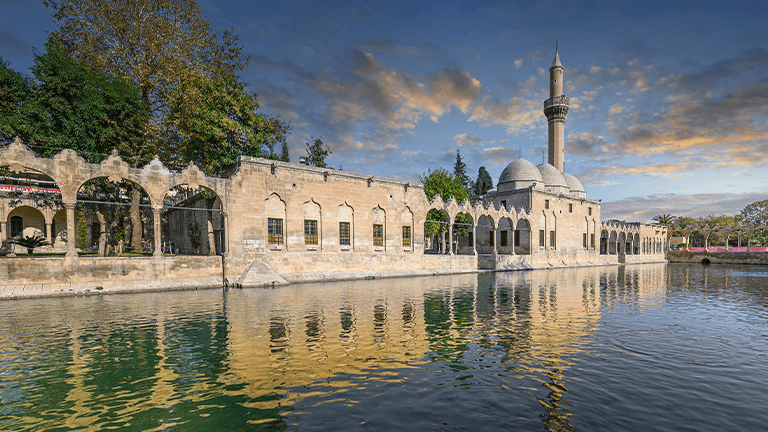
Balıklıgöl: According to legend, when the Prophet Abraham was thrown into the fire by King Nimrod, the wood transformed into fish and the fire turned into water, giving rise to Balıklıgöl. Reaching a depth of five meters, the lake is approximately 150 meters long and up to 30 meters wide. It is one of the most popular attractions for visitors to Şanlıurfa.
Takoran Valley: Formed when water levels rose following the construction of the Atatürk Dam, Takoran Valley is located in Şanlıurfa’s Siverek district. The valley offers breathtaking, untouched natural scenery and attracts visitors who enjoy exploring nature.
Halfeti: Also known as the “Hidden Paradise,” Halfeti has been home to numerous civilizations for centuries. After the construction of the Birecik Dam, half of the town was submerged, transforming Halfeti into one of the region’s most important tourist destinations. Located in Şanlıurfa province, Halfeti is home to bridges, churches, and castles and is particularly notable for its unique climate. Thanks to its microclimate, Halfeti is known as the only place in the world where black roses naturally grow.
Urfa Castle: Built in ancient times, Urfa Castle was later restored by the Ottomans and played an active role during the Crusades. Its walls, caves, and inner and outer sections continue to fascinate visitors.
Göbeklitepe: Listed as a UNESCO World Heritage Site, Göbeklitepe continues to be extensively studied by archaeologists. It is one of the foremost destinations that should be included in any trip to Şanlıurfa.
Şanlıurfa Archaeology and Mosaic Museum: Opened in 1969, the museum houses more than 70,000 artifacts. Its collection includes objects and archaeological finds from the Bronze Age, Iron Age, Neolithic, and Paleolithic periods, as well as artifacts unearthed at Göbeklitepe, offering history and art enthusiasts a remarkable glimpse into the region’s ancient past.
Was this content helpful?