
 Online Services
Trabzon Travel Guide: Thousands of Years of Layered Culture
Nestled between the Eastern Black Sea Mountains and the Black Sea, Trabzon has a cultural history spanning thousands of years. The traces, traditions, worldviews, and stories of every civilization that has called the region home have become woven into its cultural fabric, layer upon layer. This cultural heritage and architectural character can be seen throughout the city, from its streets and highland plateaus to its hills, villages, neighborhoods, avenues, and bridges, making Trabzon a true cradle of civilizations. The city’s rich historical legacy can be felt almost everywhere you go. All these details are explored in our Trabzon travel guide. The city’s history, cultural character, atmosphere, cuisine and local dishes—including what to eat in Trabzon—as well as everything you need to know for a trip to Trabzon are covered in detail in our guide.
Where Is Trabzon?
Located on the Black Sea coast and neighboring Giresun, Gümüşhane, Bayburt, and Rize, Trabzon covers a total area of 4,628 square kilometers. Along with its central district of Ortahisar, the province has 18 districts: Akçaabat, Araklı, Arsin, Beşikdüzü, Çarşıbaşı, Çaykara, Dernekpazarı, Düzköy, Hayrat, Köprübaşı, Maçka, Of, Sürmene, Şalpazarı, Tonya, Vakfıkebir, and Yomra. Trabzon is the second-largest city in the Black Sea Region after Samsun.
What to Eat in Trabzon?
A destination of exceptional local flavors, Trabzon offers specialties such as black cabbage soup, anchovy pilaf, mıhlama, corn soup, meat-stuffed cabbage rolls, sautéed pickled beans, cornbread, Swiss chard fry, guliya, sarambula, pepeçura, and Akçaabat meatballs. Each of Trabzon’s 18 districts has its own culinary specialties, and these delicious local dishes can be found throughout the province, including in many neighborhoods of Ortahisar.
A Trip to Trabzon
Known by many titles throughout history, Trabzon is also known as the City of Princes. It is worth noting that Süleyman the Magnificent, the 10th sultan of the Ottoman Empire, was born here. Having been home to dozens of civilizations, Trabzon is rich in cultural and architectural heritage, including Sumela Monastery, Nemlizade Mansion, Gülbahar Hatun Mosque, Girls’ Monastery, Taşhan, Sekiz Direkli Hamam, Trabzon Museum, and Zağnos Bridge. All of these can be explored during a trip to Trabzon.
The earliest known settlement remains in the city are located in the area between the Zağnos and Tabakhane streams. Traces of the Persians, the Kingdom of Macedon, the Romans, and the Ottoman Empire can be found throughout the city. Some of the most notable historical sites include:
Sumela Monastery: Believed to have been founded between AD 375 and 395 by the Athenian monks Barnabas and Sophronios during the Byzantine period, Sumela Monastery is nestled on the slopes amid lush green scenery. The monastery is traditionally associated with Emperor Alexios III of Trebizond as its founder and is also popularly known as the Monastery of the Virgin Mary. A highlight of every Trabzon travel guide, Sumela Monastery is one of the region’s most famous historical landmarks.
Gülbahar Hatun Mosque: Located within a külliye in the western part of Ortahisar, near Zağnos Bridge, Gülbahar Hatun Mosque was built in 1514 in memory of Gülbahar Hatun, the mother of Yavuz Sultan Selim, the ninth Ottoman sultan. The historic mosque is also known as Hatûniye Mosque or Büyük İmaret Mosque.
Trabzon Museum: Originally built as a mansion in the early 20th century, the building served as a girls’ vocational high school for 50 years. It was allocated to the Ministry of Culture in 1987 and opened as a museum in 2001 following the completion of its restoration. The museum houses ethnographic artifacts and archaeological objects.
Girls’ Monastery: Construction of this historic complex continued from the mid-14th to the late 14th century. Also known as Panagia Theoskepastos Monastery, it is located on the slopes of Boztepe overlooking the city. Its restoration was completed between 2014 and 2018. The monastery features portraits and inscriptions depicting notable figures from the period.
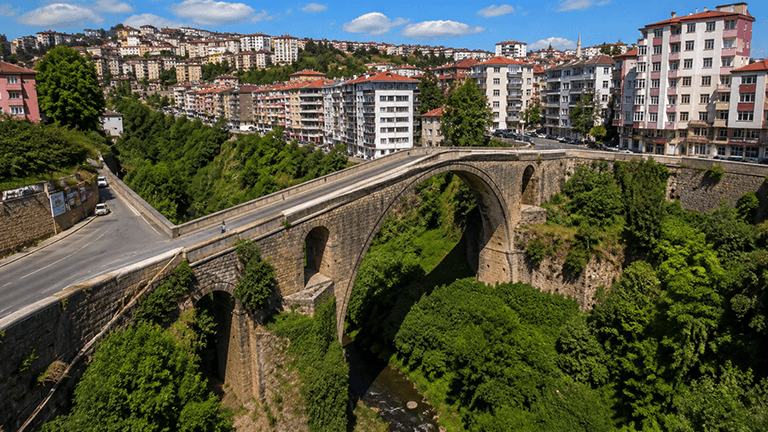
Zağnos Bridge: Located in Trabzon’s Ortahisar district, this arched bridge spans the Kuzgun Stream and bears traces of the Ottoman, Byzantine, and Roman periods. Considered one of the symbols of the city, Zağnos Bridge connects Ortahisar with Atapark. Its exact construction date remains unknown.
Çal Cave: Known as the second-longest cave in the world, Çal Cave is a completely natural formation. One of Trabzon’s important tourism attractions, the cave features an underground lake, a waterfall, and a walking trail.
Kaldıralak Plateau: Located nine kilometers from Trabzon’s Tonya district, Kaldıralak Plateau is also known as Mor Yayla, meaning “Purple Plateau.” The name is associated with the blue star flowers that grow here. Blooming for only two weeks each year, these flowers create a colorful landscape that attracts large numbers of visitors. The blue star flower is among the rare plant species protected in Türkiye under the international Bern Convention.
Was this content helpful?